Quick answer: A songwriter collaboration agreement checklist is the practical review of who contributed to a song, what ownership percentages were agreed, what credits and publishing details are known, and what questions must be resolved before release or registration.
Why collaboration needs a written record
Songwriting can happen casually: a hook in the room, a chord change from a producer, a bridge over FaceTime, a topline from a friend, or a late lyric rewrite. The creative process feels fluid, but release systems eventually ask for structured answers.
A checklist helps the team capture the agreement before memory turns into negotiation. It gives collaborators a shared record without making the session feel hostile.
Name every contributor
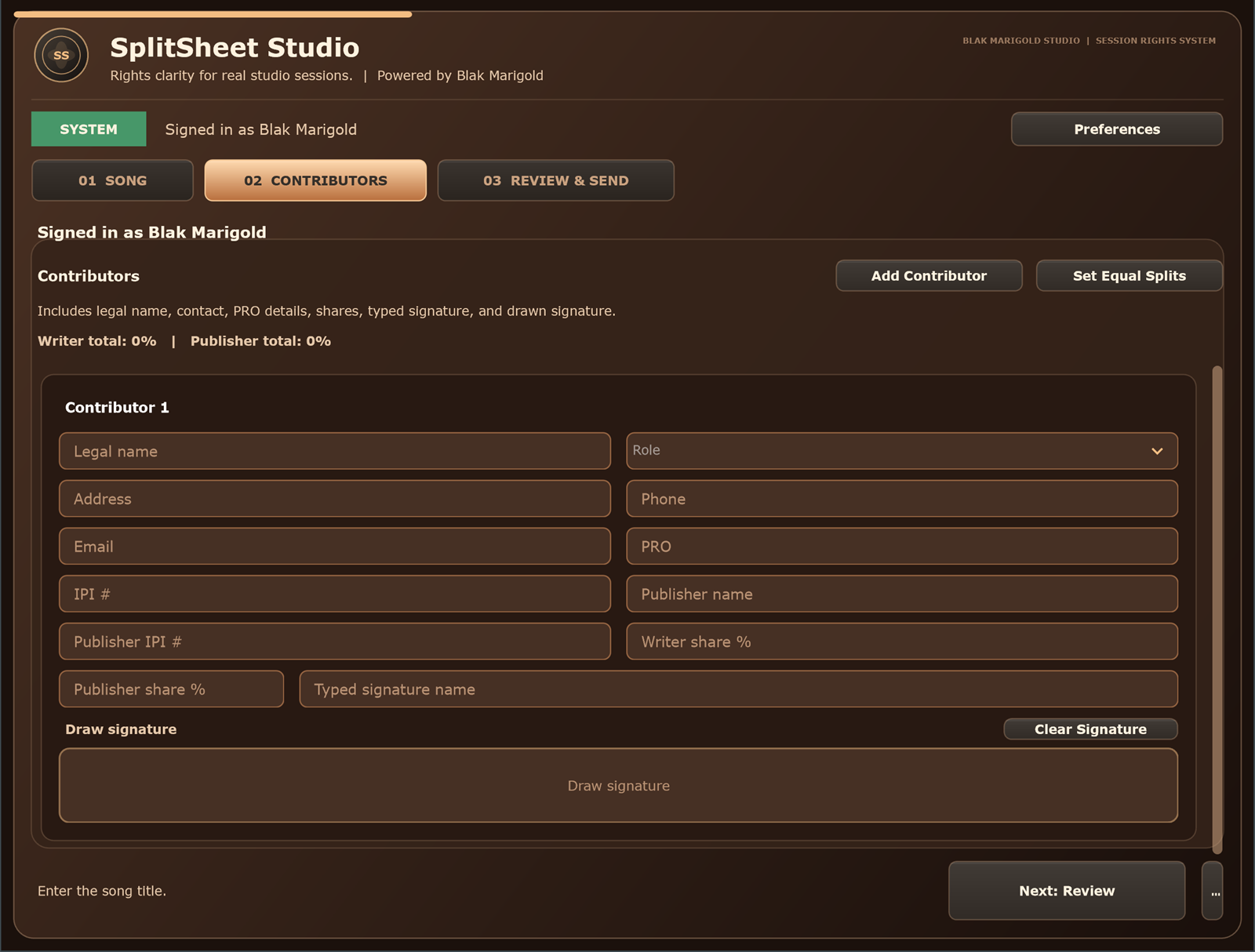
List legal names, professional names, emails, roles, and what each person contributed. Include people in the room and remote collaborators. If someone contributed to performance or engineering but not composition, record the credit separately.
Credits and ownership are related but not identical. The checklist should make both visible.
Agree on composition splits
Discuss writer shares while the session is fresh. The split sheet should total 100% and reflect the collaborators' agreement. Include publisher, PRO, and IPI information when known, but do not guess missing data.
If the team is not ready to decide, label the split as a draft and schedule a specific follow-up. Avoid letting an unresolved draft become the release record by accident.
Capture publishing and administration details
Ask whether each writer is self-administered, represented by a publisher, using an administrator, or unsure. This matters for registrations, licensing, and sync approval. The MLC guidance distinguishes self-administered writers from represented writers in its membership and registration workflows.
When someone does not know their publishing data, capture the person responsible for finding it.
Separate master and producer terms
If a producer contributed, ask whether they have a composition share, fee, producer points, master royalty, credit, or beat-license terms. Put composition ownership on the split sheet and master-side terms in a separate record.
This protects both sides. The artist does not accidentally give publishing when they meant points, and the producer does not lose a term because it was described vaguely.
List samples, loops, and approvals
Ask whether the collaboration used samples, interpolations, loops, outside stems, or reference material. Document the source and status. Also list approvals required for release, sync, remix, lyric changes, or featured artist use.
Unknown material should be marked as unknown. Pretending it is cleared can hurt the song later.
Collect signatures and distribute the same copy
Once the team agrees, send secure signature links or sign while everyone is present. Every contributor should review the full ownership picture, not only their own percentage.
After completion, send the same final PDF to everyone and store it with the release packet. That final record becomes the reference for registrations, sync prep, and future questions.
Make collaboration paperwork normal
The goal is not to scare collaborators. The goal is to protect the song. A simple message works: “Before we upload or pitch this, let's make sure everyone is named correctly and the split matches what we agreed.”
Use the split-sheet guide and the artist release checklist when the collaboration is moving toward release.
Who needs a collaboration checklist
Songwriters
Use the checklist before a writing session turns into a release, registration, or royalty argument.
Artists
Make sure features, hooks, toplines, and production contributions are captured while the session is fresh.
Producers
Clarify whether your creative contribution earns songwriting ownership, credit, fee, master royalty, or multiple rights.
Managers
Keep collaboration records consistent across split sheets, publishing, distributor uploads, and sync pitches.
Real session scenario
A hook writer joins for one hour, a producer changes the chords, and the artist finishes lyrics later. Everyone loves the song, but nobody writes down what each collaborator agreed to before release momentum begins.
Collaboration agreement checkpoints
| Checkpoint | Question to answer | Where to record it |
|---|---|---|
| Authorship | Who contributed lyrics, melody, composition, or arrangement? | Split sheet notes and session recap. |
| Ownership | What percentages did the collaborators agree to? | Signed split sheet. |
| Administration | Who has publisher, PRO, IPI, and registration details? | Metadata and publishing record. |
| Approval | Who can approve sync, samples, revisions, or release changes? | Collaboration notes or separate agreement. |
Before collaborators leave
- Name every contributor.
- Separate creative credit from ownership.
- Agree on composition splits.
- Document unresolved questions.
- Send the same completed record to everyone.
Turn this into a repeatable session system
The best music-rights workflow is boring in the right way: the same fields, same closeout habit, same storage location, and same confirmation path every time. For songwriter collaboration agreement checklist work, that means the team should not wait until release week, a sync pitch, or a payment dispute to collect the facts.
- Before the session: ask who is writing, producing, engineering, featured, managing, or controlling the master.
- During the session: capture names, emails, roles, titles, and any beat, sample, or publishing questions as they come up.
- Before people leave: confirm percentages, approval contacts, and unfinished questions while everyone can still answer.
- After the session: save the completed record beside the audio files, metadata, stems, invoices, and release notes.
That rhythm helps artists, producers, studios, managers, and sync teams move faster because the catalog becomes organized by default instead of cleaned up in a panic.
Green-light questions before you move forward
Before treating this songwriting workflow as finished, make sure a person outside the session could understand the record without calling everyone back. A strong answer should be specific enough for a collaborator, publisher, studio admin, or sync clearance contact to act on it later.
- Does the record name every person or company that must approve, register, deliver, or receive a copy?
- Do the percentages, identifiers, credits, and contacts match across the split sheet, metadata, distributor upload, and licensing notes?
- Can the team explain what is still unknown without turning the unknown field into a guess?
- Would the same information help a music supervisor, publisher, manager, or studio assistant move faster under a deadline?
Frequently asked questions
What is a songwriter collaboration agreement checklist?
It is a practical checklist for documenting contributors, shares, credits, publishing details, samples, approvals, and signatures.
Is a split sheet a collaboration agreement?
A split sheet documents composition ownership, but broader collaboration terms may need additional agreement language.
When should songwriters discuss splits?
Ideally before the session ends, while contributions and expectations are fresh.
Does every performer get a songwriting split?
Not automatically. Performance credit and composition ownership are different.
Can a producer be a songwriter?
Yes, if the producer contributed to the composition and the parties agree to a writer share.
What if we do not know publisher information yet?
Mark it as unknown, assign follow-up, and avoid guessing.
Should samples be listed on collaboration paperwork?
Yes. Samples, interpolations, loops, and outside stems should be disclosed and tracked.
Do all collaborators need a copy?
Yes. Everyone who signs should receive the same completed record.
Does this replace legal advice?
No. It is a workflow checklist, not legal advice.
How does Split Sheet Studio help collaborators?
It helps collaborators validate totals, collect signatures, and preserve a final PDF record of the agreed split.