Quick answer: A split sheet records composition ownership among songwriters, while a producer agreement can cover production fees, producer points, master royalties, credits, deliverables, approvals, and other master-side or service terms.
Why producer paperwork gets confusing
Producer conversations often happen fast: “I get 25,” “I need points,” “give me publishing,” or “credit me as producer.” Those phrases can mean different things to different people. Without clear documents, an artist may think one number means a composition share while the producer thinks it means master royalties.
The fix is not complicated: separate the rights. Put songwriting ownership on the split sheet. Put production services, fees, points, deliverables, and master terms in a producer agreement or related written record.
What belongs on the split sheet
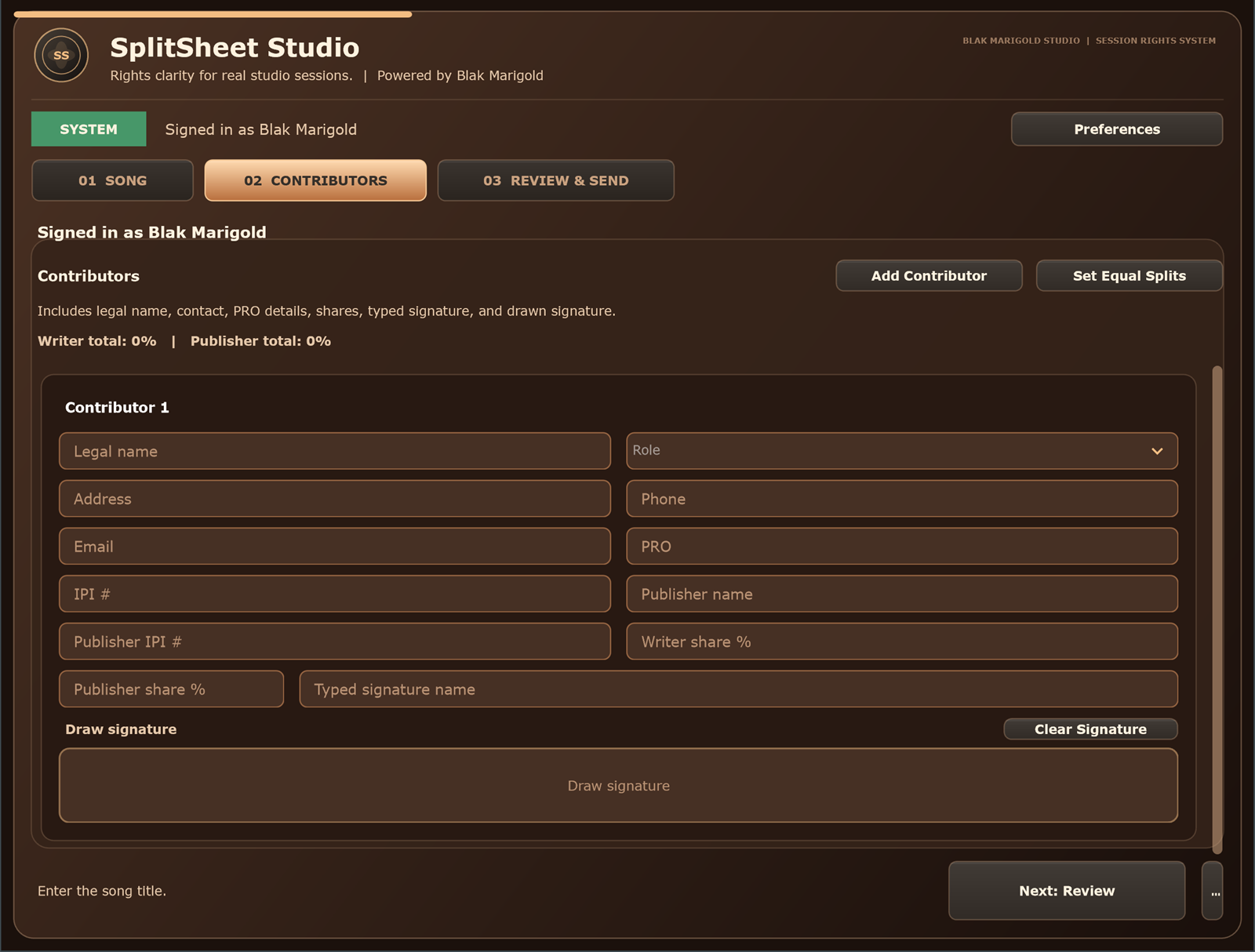
The split sheet should identify composition contributors and percentages. If the producer contributed protectable songwriting elements and the team agrees to a composition share, include that share with the other writers so the total equals 100%.
Do not use the split sheet as the only place to document a fee, recoupment term, stem delivery obligation, credit wording, or producer point. Those terms need their own clarity.
What belongs in a producer agreement
A producer agreement may cover the fee, payment timing, deliverables, revisions, stems, session files, credit, approvals, representations about samples, producer points, accounting, recoupment, and master-side royalties. The scope depends on the actual deal.
For higher-stakes releases, the parties should use qualified legal help. For everyday workflow, the important habit is labeling every promise and saving the record before distribution.
Where beat licenses fit
A beat license is not automatically the same as a producer agreement or split sheet. It may grant permission to use a production under defined limits while reserving other rights. Exclusive and nonexclusive licenses can still include restrictions.
Review term, territory, monetization, sync, Content ID, stems, publishing, credit, samples, and transfer language. If the producer also owns a composition share, document that separately.
Producer points are not publishing by default
Producer points commonly refer to master-side royalties. Publishing or composition share refers to the underlying song. A producer can have one, both, or neither depending on the agreement.
Before release, ask: percentage of what? Gross or net? Master revenue or composition income? Recoupable or not? Paid by whom? Accounted when? Those questions prevent one number from becoming a dispute.
Credit language should be exact
Credit affects reputation and metadata. Write the exact credit: produced by, co-produced by, additional production, beat by, mixed by, vocal production by, or another agreed phrase. Make sure distributor metadata, social captions, liner notes, and studio delivery match.
Credit does not automatically equal ownership. Ownership should be stated in the relevant agreement.
Use session closeout to separate the terms
At the end of the session, ask whether the producer is receiving a composition share, master royalty, fee, beat-license payment, credit, or other approval rights. Then place each answer in the right record.
Use the session closeout workflow and the producer splits guide together.
Review all producer paperwork before release
Before upload, compare the split sheet, producer agreement, beat license, invoice, credits, and metadata. The same names and roles should appear consistently. If something conflicts, fix it before the release is live.
This is also the moment to check sample disclosures. The Copyright Office reminds musicians not to assume third-party work can be used freely.
Who needs producer paperwork separation
Artists
Know when you are agreeing to songwriting ownership, master royalties, fees, credits, or beat-license terms.
Producers
Protect the exact deal you made without relying on a single vague percentage.
Managers
Compare producer agreements, split sheets, invoices, and distributor credits before release.
Studios
Help clients separate creative ownership from production services during closeout.
Real session scenario
The producer says they get 25%. The artist thinks that means publishing. The manager thinks it means master points. The distributor only asks for credits. One number has become four different assumptions.
Producer agreement versus split sheet
| Document | Usually covers | Do not use it to replace |
|---|---|---|
| Split sheet | Composition writers and ownership percentages. | Producer fee, master royalty, or beat-license restrictions. |
| Producer agreement | Fee, points, deliverables, credits, approvals, and master-side terms. | Co-writer confirmation when songwriting share exists. |
| Beat license | Permission to use an instrumental under specific terms. | Full copyright transfer unless it says so. |
| Invoice/receipt | Payment trail. | Ownership agreement. |
Producer paperwork checklist
- Label every percentage by right.
- Document composition share on the split sheet.
- Document master points separately.
- Save the beat license and sample notes.
- Match credits across all release systems.
Turn this into a repeatable session system
The best music-rights workflow is boring in the right way: the same fields, same closeout habit, same storage location, and same confirmation path every time. For producer agreement vs split sheet work, that means the team should not wait until release week, a sync pitch, or a payment dispute to collect the facts.
- Before the session: ask who is writing, producing, engineering, featured, managing, or controlling the master.
- During the session: capture names, emails, roles, titles, and any beat, sample, or publishing questions as they come up.
- Before people leave: confirm percentages, approval contacts, and unfinished questions while everyone can still answer.
- After the session: save the completed record beside the audio files, metadata, stems, invoices, and release notes.
That rhythm helps artists, producers, studios, managers, and sync teams move faster because the catalog becomes organized by default instead of cleaned up in a panic.
Green-light questions before you move forward
Before treating this producers workflow as finished, make sure a person outside the session could understand the record without calling everyone back. A strong answer should be specific enough for a collaborator, publisher, studio admin, or sync clearance contact to act on it later.
- Does the record name every person or company that must approve, register, deliver, or receive a copy?
- Do the percentages, identifiers, credits, and contacts match across the split sheet, metadata, distributor upload, and licensing notes?
- Can the team explain what is still unknown without turning the unknown field into a guess?
- Would the same information help a music supervisor, publisher, manager, or studio assistant move faster under a deadline?
Frequently asked questions
Is a producer agreement the same as a split sheet?
No. A split sheet records composition ownership. A producer agreement can cover production fees, credits, master royalties, deliverables, and other terms.
Does a producer automatically get publishing?
Not automatically. A producer receives composition ownership only when authorship and agreement support that share.
Are producer points the same as writer share?
No. Producer points usually refer to master-side royalties, while writer share refers to the composition.
Can a producer be on the split sheet?
Yes, when the parties agree the producer contributed to the composition and owns a writer share.
Does buying a beat mean I own the master?
Not necessarily. The beat license controls what rights you receive.
Should producer credits be in writing?
Yes. Exact credit language should be saved and matched across metadata and release materials.
Where do sample warranties belong?
They are usually part of a producer agreement, beat license, or sample disclosure record, not just a split sheet.
Can one document cover everything?
Sometimes a broader agreement can cover multiple terms, but the categories should still be labeled clearly.
What should artists check before release?
Compare splits, producer terms, beat license, credits, master notes, samples, and distributor metadata.
How does Split Sheet Studio help producers?
It captures agreed composition splits and keeps that record separate from other producer deal terms.