Quick answer: A music split sheet is a written record of who helped create a song and the percentage of the underlying composition each songwriter or composer owns.
What a music split sheet records
A split sheet documents ownership of the musical work: the melody, lyrics, and other protectable parts of the composition. It identifies each contributor and the percentage that contributor owns.
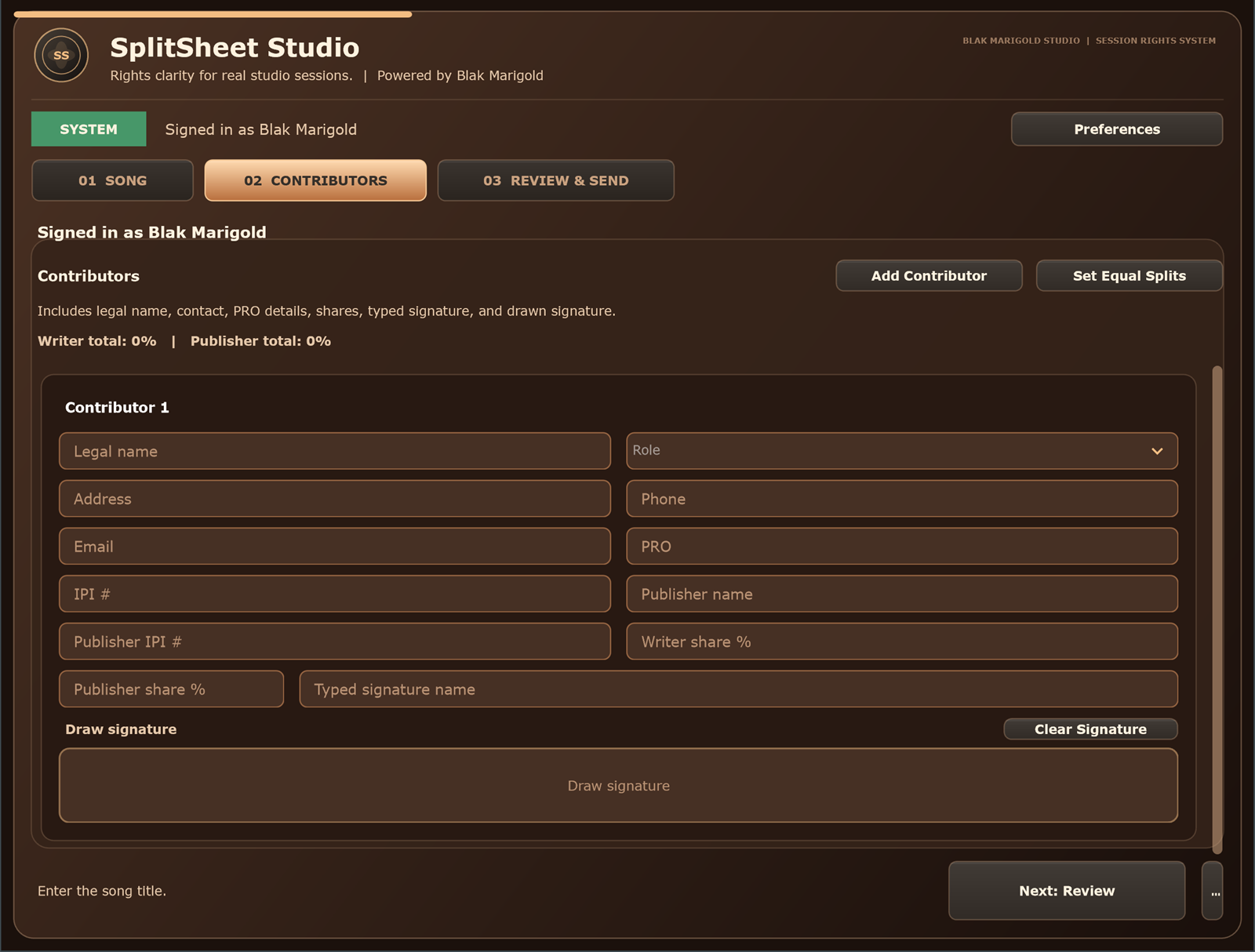
A strong record includes the song title and alternate title, session date and location, legal names, creator roles, emails, performance rights organizations, IPI or CAE numbers, publishers, writer shares, publisher details, signatures, and agreement date.
Why producers, artists, and songwriters need one
Memory is not a rights-management system. A song may reach a distributor, publisher, label, manager, or music supervisor months after the session. If ownership was never documented, every downstream task becomes slower.
A clean split record reduces disputes, supports accurate registration, and gives managers one reliable contact list. Everyone reviews the same percentages instead of relying on different text threads.
Composition splits are not master ownership
A released song commonly contains two copyright-protected works: the musical composition and the sound recording. A split sheet normally covers the composition. The master may have different owners and revenue terms.
Two writers can own the composition 50/50 while one artist or label owns the master. A producer may receive a songwriting share, master royalty, fee, or combination. Document each right in the correct agreement.
How collaborators decide songwriting splits
There is no universal formula that determines a fair split. Collaborators may split equally, divide ownership according to contribution, or negotiate another arrangement. The goal is informed agreement before release pressure begins.
- Discuss contributions to lyrics, melody, harmony, and composition.
- Separate songwriting from featured-artist fees and producer master points.
- Confirm that the composition ownership totals exactly 100%.
- Leave a disputed record unresolved instead of forcing a false final document.
A five-minute end-of-session workflow
- Enter the working title, date, and location.
- Add every contributor using legal names and current emails.
- Enter roles, PROs, publishers, and shares.
- Validate the 100% total.
- Sign in the room or send secure remote signature links.
- Deliver the completed copy to every contributor.
Split Sheet Studio is designed to keep this closeout inside the recording session, including through its VST3 workflow.
Split sheet mistakes that delay releases
Common failures include missing legal names, percentages that do not total 100%, confusing composition ownership with master ownership, leaving out a producer who contributed to the song, and using old contact information.
A blank publisher field should trigger a question, not an assumption. Review the record before submission so the data is complete, readable, and accepted by every contributor.
What to do after everyone signs
Store the completed record, send every party a copy, and use the same data when registering the work with PROs, publishers, administrators, and The MLC where applicable. Keep it beside the song metadata, master files, licenses, and release records.
For collaborators in different locations, use our remote split-sheet guide.
How each music role should use a split sheet
Artists
Use the split sheet to protect the song before release pressure starts. A clean record keeps co-writer conversations from turning into memory battles.
Producers
Separate songwriting ownership from producer points, beat license terms, and master royalties. Put each deal layer in the right document.
Studios
Make the split sheet part of session closeout. The studio does not need to decide ownership; it needs a repeatable way to capture the agreed record.
Sync teams
A supervisor or clearance contact needs fast answers. Signed splits, publisher contacts, and master ownership are the difference between easy clearance and delay.
Real session scenario
Three people write a hook, one producer builds the track, and a featured artist adds a melodic change at the end of the night. Without a signed split sheet, everyone may remember the contribution differently two months later when a sync opportunity appears.
Split sheet fields that matter most
| Field | Why it matters | Best practice |
|---|---|---|
| Legal name and email | Identifies the person who can sign and receive the completed record. | Collect it in the room or through a secure invitation link. |
| Writer share | Shows each contributor's composition ownership. | Validate that total composition ownership equals 100%. |
| Publisher, PRO, and IPI | Helps registrations and royalty matching downstream. | Leave unknown data marked as unknown rather than guessing. |
| Master owner/contact | Sync and licensing requests may require recording approval too. | Store it beside the split sheet, even if it is not the same document. |
End-of-session split sheet checklist
- Name every contributor who helped create the composition.
- Agree on writer shares before anyone leaves.
- Confirm publisher and PRO details when known.
- Record whether master ownership is separate.
- Send the completed PDF to every signer.
Turn this into a repeatable session system
The best music-rights workflow is boring in the right way: the same fields, same closeout habit, same storage location, and same confirmation path every time. For music split sheet work, that means the team should not wait until release week, a sync pitch, or a payment dispute to collect the facts.
- Before the session: ask who is writing, producing, engineering, featured, managing, or controlling the master.
- During the session: capture names, emails, roles, titles, and any beat, sample, or publishing questions as they come up.
- Before people leave: confirm percentages, approval contacts, and unfinished questions while everyone can still answer.
- After the session: save the completed record beside the audio files, metadata, stems, invoices, and release notes.
That rhythm helps artists, producers, studios, managers, and sync teams move faster because the catalog becomes organized by default instead of cleaned up in a panic.
Green-light questions before you move forward
Before treating this split sheets workflow as finished, make sure a person outside the session could understand the record without calling everyone back. A strong answer should be specific enough for a collaborator, publisher, studio admin, or sync clearance contact to act on it later.
- Does the record name every person or company that must approve, register, deliver, or receive a copy?
- Do the percentages, identifiers, credits, and contacts match across the split sheet, metadata, distributor upload, and licensing notes?
- Can the team explain what is still unknown without turning the unknown field into a guess?
- Would the same information help a music supervisor, publisher, manager, or studio assistant move faster under a deadline?
Frequently asked questions
Is a split sheet a legal contract?
A signed split sheet can be important evidence of agreed ownership, but it may not cover every term in a full collaboration or publishing agreement. Ask a qualified music attorney about your situation.
When should a split sheet be completed?
Complete it before everyone leaves the session or immediately after the song is created, while the contributor list and percentages are fresh.
Do producer points belong on a songwriting split sheet?
Usually not. Songwriting shares concern the composition. Producer points commonly concern master royalties and should be documented separately unless the agreement clearly combines both subjects.
Can a split sheet be signed remotely?
Yes. A remote workflow can send each contributor a secure link to review the same song data, confirm percentages, and sign from another location.
Do split sheet percentages need to equal 100%?
Yes. Composition ownership should resolve to a complete 100%. Follow the specific display rules of the organization where the work is later registered.