Quick answer: Recording studio paperwork is the ownership, credit, permission, payment, and metadata record set that moves a song from session to defensible release and licensing asset.
Before the session
- Confirm the booking and payment terms.
- Identify the artist, producer, engineer, and expected collaborators.
- Ask about beats, samples, or third-party material.
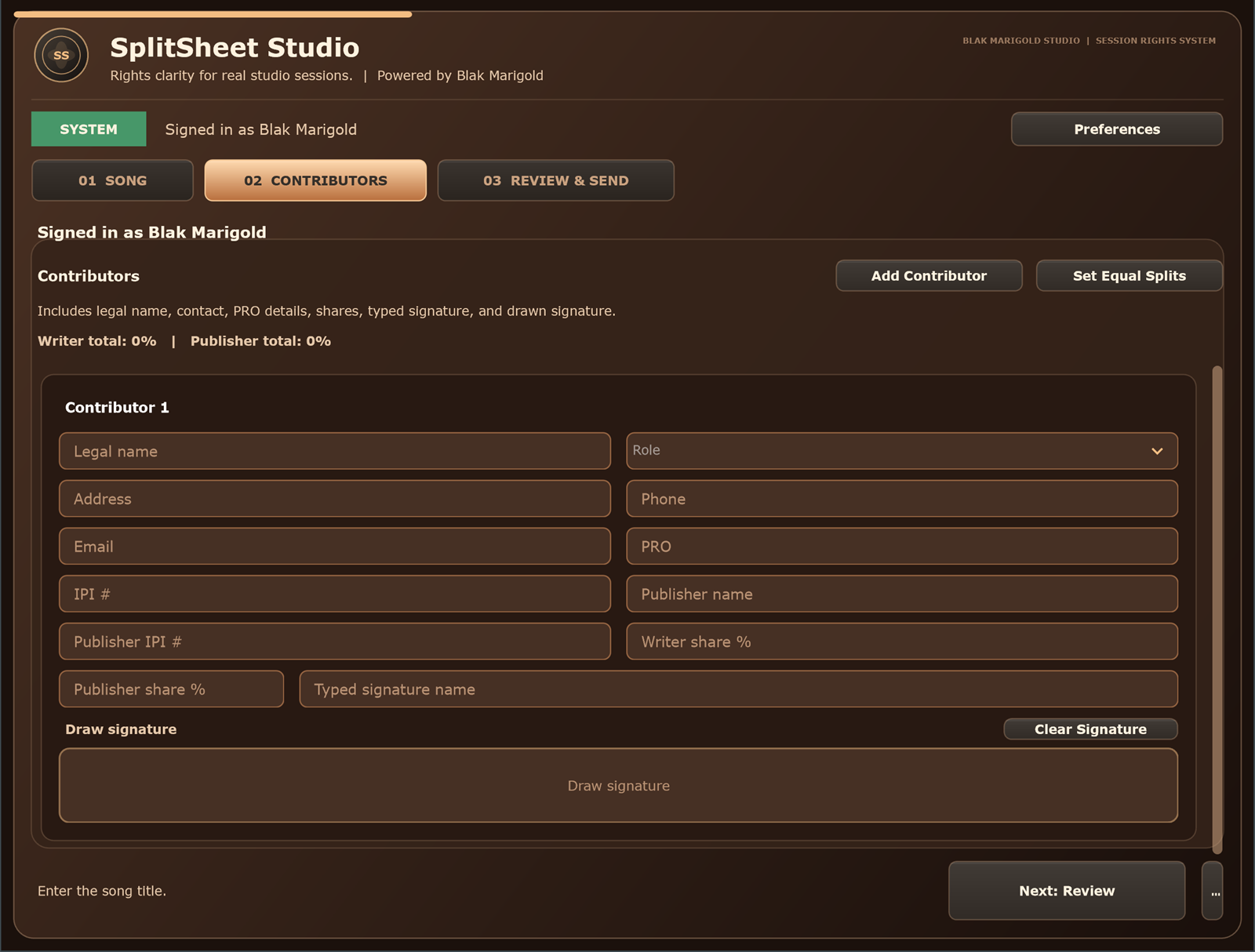
- Prepare contributor fields and the split workflow.
- Clarify the service or collaboration relationship where applicable.
During the session
Track who contributes lyrics, melody, harmony, production, performance, engineering, and other work. Contribution does not automatically determine ownership, but an accurate activity record makes the conversation clearer.
Save real names and emails as people arrive. Do not wait until release week.
At the end of the session
- Finalize the working and alternate titles.
- Agree on composition splits totaling 100%.
- Record publishers, PROs, and IPIs when known.
- Confirm credits and master compensation separately.
- Sign or send remote invitations.
- Export a recap and back up the files.
ISRC, ISWC, and IPI without confusion
ISRC identifies a specific recording. ISWC identifies a musical composition. IPI identifies creators and publishers in rights systems.
An ISRC is not a copyright registration and should never be reused for a different recording.
Before distribution and release
- Confirm master ownership and delivery acceptance.
- Register the composition through appropriate channels.
- Assign or obtain the recording's ISRC.
- Review names, title, featured credits, and metadata.
- Clear samples and interpolations.
- Register copyrights where appropriate.
Build a sync-ready song folder
Store the full mix, instrumental, clean version, stems, lyrics, split sheet, master contact, sample clearances, writer and publisher contacts, identifiers, and creative description together.
A clean folder turns a frantic clearance email into a professional response.
Turn paperwork into a repeatable studio system
Use the same naming convention, required fields, validation, signature flow, and storage location for every session. Assign one person to close the record before the project leaves production.
Pair this with the five-minute session closeout workflow, the sync checklist, and the producer guide.
How studios can turn paperwork into a product advantage
Studio owners
A consistent closeout workflow makes the studio feel more professional and reduces post-session confusion.
Engineers
You should not have to argue ownership; you need a fast way to capture the agreement the collaborators make.
Artists
Ask the studio to help capture credits, splits, and metadata while everyone is still present.
Sync producers
Studios that organize paperwork create songs that are easier to pitch, clear, and monetize.
Real session scenario
The mix sounds great, the artist is excited, and everyone leaves. A month later, the distributor needs credits, the manager asks for publishing data, and the producer wants confirmation of the split. The paperwork should have been part of the session, not a rescue mission.
Studio paperwork operating system
| Moment | Capture this | Owner |
|---|---|---|
| Before session | Booking terms, participants, samples, expected deliverables. | Studio manager or assistant. |
| During session | Contributors, roles, credits, contact information. | Engineer or session lead. |
| Closeout | Splits, signatures, master notes, final file locations. | Session lead. |
| After session | Final PDF, metadata folder, backups, invoices. | Studio/admin team. |
Studio closeout checklist
- Confirm title and alternate title.
- Capture all contributors and credits.
- Validate composition splits.
- Document master and producer terms separately.
- Deliver the split PDF and session recap.
Turn this into a repeatable session system
The best music-rights workflow is boring in the right way: the same fields, same closeout habit, same storage location, and same confirmation path every time. For recording studio paperwork work, that means the team should not wait until release week, a sync pitch, or a payment dispute to collect the facts.
- Before the session: ask who is writing, producing, engineering, featured, managing, or controlling the master.
- During the session: capture names, emails, roles, titles, and any beat, sample, or publishing questions as they come up.
- Before people leave: confirm percentages, approval contacts, and unfinished questions while everyone can still answer.
- After the session: save the completed record beside the audio files, metadata, stems, invoices, and release notes.
That rhythm helps artists, producers, studios, managers, and sync teams move faster because the catalog becomes organized by default instead of cleaned up in a panic.
Green-light questions before you move forward
Before treating this studio operations workflow as finished, make sure a person outside the session could understand the record without calling everyone back. A strong answer should be specific enough for a collaborator, publisher, studio admin, or sync clearance contact to act on it later.
- Does the record name every person or company that must approve, register, deliver, or receive a copy?
- Do the percentages, identifiers, credits, and contacts match across the split sheet, metadata, distributor upload, and licensing notes?
- Can the team explain what is still unknown without turning the unknown field into a guess?
- Would the same information help a music supervisor, publisher, manager, or studio assistant move faster under a deadline?
Frequently asked questions
What paperwork should be completed in a recording session?
Document contributors and splits, contacts, credits, master or service terms, samples, featured artists, and appropriate signatures.
What is an IPI number?
An IPI identifies an interested party such as a creator or publisher in music-rights systems. It is different from a private PRO account number.
What is the difference between ISRC and ISWC?
ISRC identifies a recording. ISWC identifies a musical work or composition.
Should engineers be listed on a split sheet?
List an engineer as a composition owner only if the parties agree that the engineer contributed songwriting. Engineering credit and payment should be documented separately.
Where should studios store completed records?
Use secure, access-controlled storage with backups and consistent song folders. Give contributors their completed copies.