Quick answer: Music metadata identifies a composition, recording, creator, publisher, owner, release, and credit. ISRC, ISWC, and IPI identify different entities and are not interchangeable.
Why music metadata matters
Streaming, publishing, royalty, licensing, and discovery systems process huge catalogs. They rely on names, titles, identifiers, and ownership data to connect usage with the correct people and works.
Errors create mismatches: a creator may be listed under the wrong name or a recording may not connect to its composition.
ISRC identifies a recording
The International Standard Recording Code uniquely identifies a sound or music video recording. Official guidance says it is not used to identify compositions, products, or performers.
Maintain the ISRC with artist, title, version, duration, content type, and publication date. Never reuse it for another recording.
ISWC identifies a musical work
The International Standard Musical Work Code identifies the composition. CISAC describes it as connecting the work title and creators, including authors, composers, and arrangers.
One song may have one ISWC while multiple recordings each have their own ISRC.
IPI identifies creators and publishers
The Interested Party Information number helps distinguish songwriters, composers, and publishers within rights systems. It is valuable when names are common or represented in multiple territories.
Use the IPI tied to the exact identity in the registration. Do not substitute private account credentials.
Credits are data, not decoration
Record songwriter, producer, featured artist, engineer, mixer, mastering engineer, musician, and studio credits consistently. Verify spelling and professional names.
Creative credit and ownership are related but not identical. Someone can deserve credit without owning composition or master rights.
Create one source of truth
Maintain a canonical record containing titles, writers, shares, publishers, IPIs, ISWC, recording versions, ISRCs, master owners, credits, lyrics, release data, and contacts.
Update downstream platforms from that record instead of rebuilding metadata from memory.
The release metadata checklist
- Song and alternate titles.
- Primary and featured artists.
- Writers and composition shares.
- Publishers, administrators, PROs, and IPIs.
- ISWC when assigned.
- ISRC for each recording.
- Master owner and licensing contact.
- Creative credits, lyrics, language, and version details.
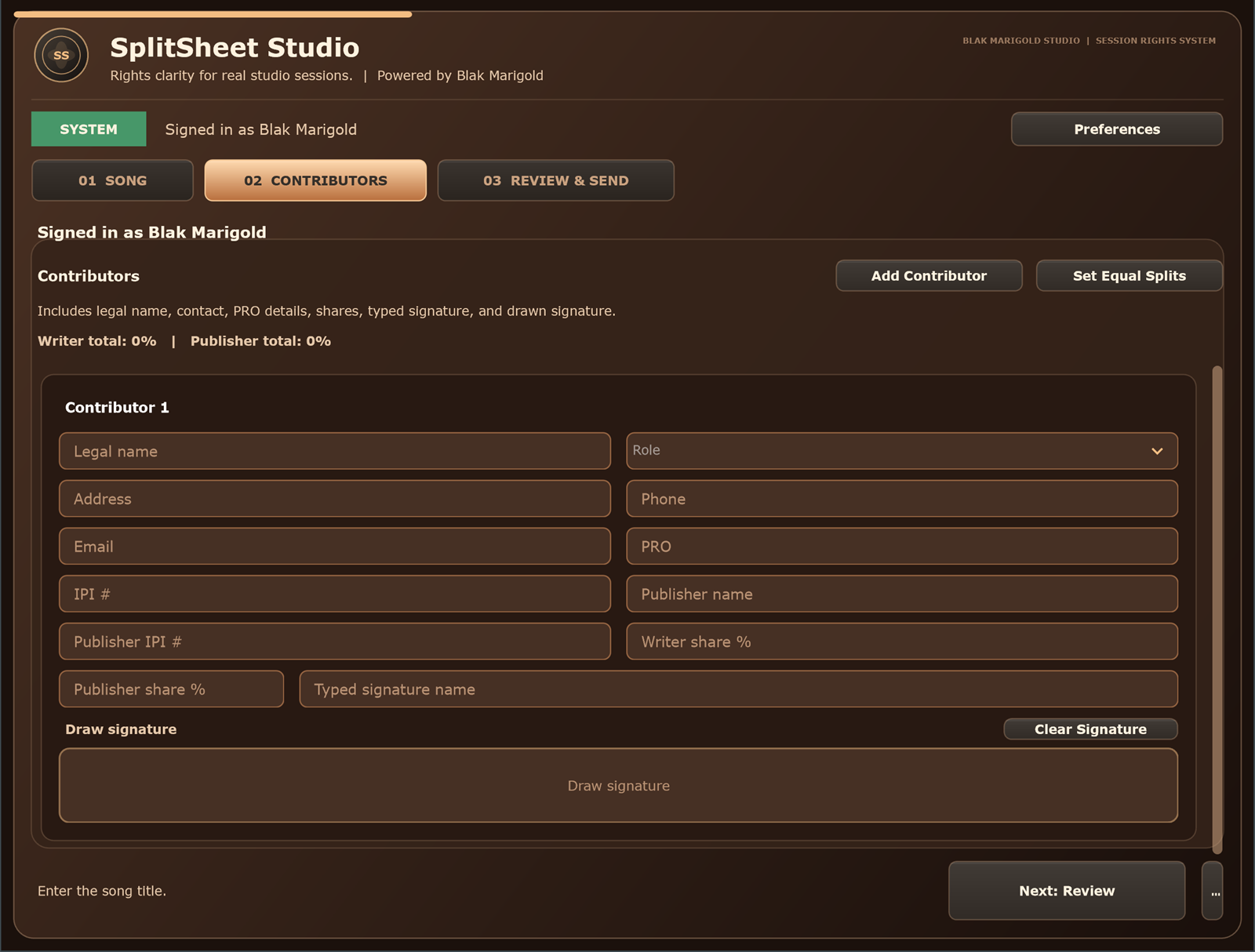
Connect the data to the signed record using the split-sheet guide.
Metadata priorities by music role
Artists
Metadata is how platforms, royalties, and licensors connect your release to the right people.
Producers
Correct credits and identifiers help your work remain visible after files leave the session.
Studios
A metadata checklist makes the studio more valuable because clients leave with release-ready information.
Sync teams
Clean metadata makes catalog search, clearance, cue sheets, and AI discovery more reliable.
Real session scenario
A song has the right file, wrong spelling for a writer, missing IPI, and no connection between the ISRC and composition record. The music exists, but the business systems cannot confidently match it.
Identifier cheat sheet
| Identifier | Identifies | Common mistake |
|---|---|---|
| ISRC | A specific recording or music video. | Using it as a song composition ID. |
| ISWC | The musical work/composition. | Expecting it before the work is assigned one. |
| IPI | A writer, composer, or publisher identity. | Treating it as a private login number. |
| UPC/EAN | A release product. | Using it to represent individual song ownership. |
Metadata source-of-truth checklist
- Confirm exact titles and alternate titles.
- Capture writers, shares, publishers, PROs, and IPIs.
- Add ISRCs for each recording version.
- Add ISWC when assigned.
- Store lyrics, explicit status, credits, and licensing contacts.
Turn this into a repeatable session system
The best music-rights workflow is boring in the right way: the same fields, same closeout habit, same storage location, and same confirmation path every time. For music metadata work, that means the team should not wait until release week, a sync pitch, or a payment dispute to collect the facts.
- Before the session: ask who is writing, producing, engineering, featured, managing, or controlling the master.
- During the session: capture names, emails, roles, titles, and any beat, sample, or publishing questions as they come up.
- Before people leave: confirm percentages, approval contacts, and unfinished questions while everyone can still answer.
- After the session: save the completed record beside the audio files, metadata, stems, invoices, and release notes.
That rhythm helps artists, producers, studios, managers, and sync teams move faster because the catalog becomes organized by default instead of cleaned up in a panic.
Green-light questions before you move forward
Before treating this music metadata workflow as finished, make sure a person outside the session could understand the record without calling everyone back. A strong answer should be specific enough for a collaborator, publisher, studio admin, or sync clearance contact to act on it later.
- Does the record name every person or company that must approve, register, deliver, or receive a copy?
- Do the percentages, identifiers, credits, and contacts match across the split sheet, metadata, distributor upload, and licensing notes?
- Can the team explain what is still unknown without turning the unknown field into a guess?
- Would the same information help a music supervisor, publisher, manager, or studio assistant move faster under a deadline?
Frequently asked questions
Does an ISRC identify a song or a recording?
An ISRC identifies a specific sound or music video recording, not the underlying composition.
What does an ISWC identify?
An ISWC is a globally recognized identifier for a musical work and connects its title and creators.
Is an IPI the same as a PRO account number?
No. An IPI identifies a creator or publisher in rights systems. Private account numbers serve different purposes.
Can the same recording receive a new ISRC after ownership changes?
Generally, the ISRC remains with the unchanged recording and should not be reassigned solely because ownership changes.
Why do alternate titles matter?
Alternate titles help systems recognize that differently styled or parenthetical titles refer to the same work or recording.