Quick answer: A songwriting split divides ownership of the composition among its creators. Writer share identifies the creators' portions, while publisher share identifies who administers or receives the publishing side.
Start with one composition ownership pie
When collaborators say a song is split 50/50, they usually mean each writer owns half of the composition. That ownership picture should resolve to 100%.
Confusion starts when creators mix that calculation with a PRO's payment display. Preserve the underlying agreement first, then enter it in the format required by each platform.
Why PRO share scales can look different
Organizations may display shares using different conventions. BMI's registration guidance describes a 200% scale made of 100% writer shares and 100% publisher shares. Other workflows present one 100% composition total.
Keep a master record of the collaborators' agreement and follow each organization's current instructions when registering.
How self-published writers handle publishing
A self-administered songwriter has not assigned administration of the relevant share to an outside publisher or administrator. The MLC allows eligible self-administered writers to become Members and register the works they administer for U.S. digital audio mechanical royalties.
Self-published does not mean no paperwork. The creator is responsible for accurate registrations, ownership data, and updates.
How to lead the split conversation
- Name everyone who contributed to the composition.
- Discuss creative contributions while the session is fresh.
- State proposed percentages out loud.
- Separate composition shares from master royalties and fees.
- Confirm the complete ownership total.
- Send the same final record to all parties.
The data to collect before registration
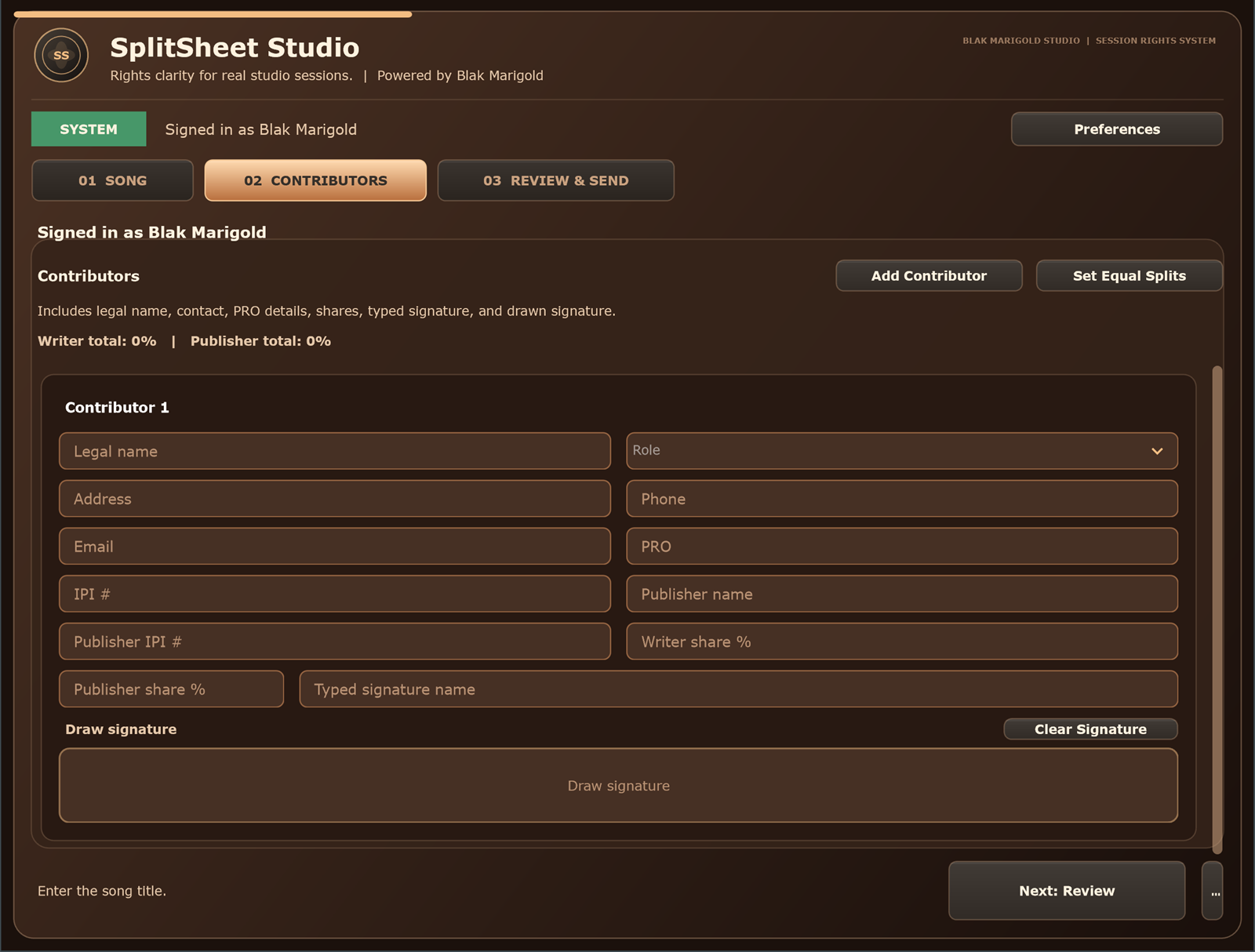
Capture legal names, professional names, roles, PROs, IPI numbers, publishing entities, publisher IPIs, writer percentages, title, alternate title, and contacts. These fields reduce duplicate records and mismatched claims.
Next, read our PRO guide and The MLC guide.
Who needs writer and publisher share clarity
Songwriters
Understand whether a number represents composition ownership, writer share display, or publisher administration before saying yes.
Producers
A songwriting percentage is not the same as a master royalty. Write both down separately when both exist.
Publishers
Consistent writer, publisher, PRO, and IPI data reduces registration conflicts and missing income.
Managers
Keep one ownership summary that can be translated into each platform's required share format.
Real session scenario
A manager asks whether a song is split 25/25/50, but the PRO registration screen shows writer and publisher fields separately. If the team does not understand the display scale, one accurate agreement can accidentally become a mismatched registration.
Share terms in plain English
| Term | What it describes | Common mistake |
|---|---|---|
| Writer share | The creator side of composition income. | Treating a performer credit as automatic songwriting ownership. |
| Publisher share | The publishing or administration side of the composition. | Leaving self-administered writers with no publishing contact. |
| Composition total | The full ownership of the song itself. | Mixing a 100% ownership record with a 200% PRO display. |
| Master royalty | A payment tied to the sound recording. | Calling producer points publishing. |
Clean split-to-registration checklist
- Start with the signed 100% composition ownership agreement.
- Collect writer legal names and IPIs.
- Collect publisher/admin names and IPIs.
- Follow each PRO's current entry format.
- Store screenshots or confirmations after registration.
Turn this into a repeatable session system
The best music-rights workflow is boring in the right way: the same fields, same closeout habit, same storage location, and same confirmation path every time. For songwriting splits work, that means the team should not wait until release week, a sync pitch, or a payment dispute to collect the facts.
- Before the session: ask who is writing, producing, engineering, featured, managing, or controlling the master.
- During the session: capture names, emails, roles, titles, and any beat, sample, or publishing questions as they come up.
- Before people leave: confirm percentages, approval contacts, and unfinished questions while everyone can still answer.
- After the session: save the completed record beside the audio files, metadata, stems, invoices, and release notes.
That rhythm helps artists, producers, studios, managers, and sync teams move faster because the catalog becomes organized by default instead of cleaned up in a panic.
Green-light questions before you move forward
Before treating this publishing workflow as finished, make sure a person outside the session could understand the record without calling everyone back. A strong answer should be specific enough for a collaborator, publisher, studio admin, or sync clearance contact to act on it later.
- Does the record name every person or company that must approve, register, deliver, or receive a copy?
- Do the percentages, identifiers, credits, and contacts match across the split sheet, metadata, distributor upload, and licensing notes?
- Can the team explain what is still unknown without turning the unknown field into a guess?
- Would the same information help a music supervisor, publisher, manager, or studio assistant move faster under a deadline?
Frequently asked questions
What is a writer share?
Writer share is the portion of composition income allocated to the songwriter or composer based on that creator's agreed ownership.
What is a publisher share?
Publisher share is the portion administered or collected by a publisher, administrator, or self-published writer, depending on the agreement and income type.
Can an independent songwriter own the publisher share?
Yes. A songwriter can be self-administered and retain publishing rights, although registration and collection requirements vary.
Why does BMI show 200%?
BMI uses a registration scale of 100% writer shares plus 100% publisher shares. That display convention does not create two separate composition ownership pies.
Should collaborators split a song equally?
They may, but equal splits are a business choice, not an automatic rule. The collaborators should discuss contributions and agree before signing.