Quick answer: One-stop music licensing means the people pitching a song can identify the approval path for both the composition and the master quickly enough for a supervisor, brand, film, game, or trailer team to trust the clearance process.
What one-stop music licensing means
In sync conversations, one-stop is shorthand for speed and confidence. A music supervisor wants to know who can approve the song, who can approve the recording, whether all contributors are reachable, and whether the quoted license can actually be granted.
The phrase does not erase the two-rights structure of music. A song can still involve composition owners, publishers, administrators, master owners, producers, featured artists, labels, sample owners, and approval restrictions. One-stop only works when the team has mapped those people and documents clearly.
Why clearance can beat a perfect pitch
Sync opportunities often move on tight deadlines. A track may be emotionally perfect for a scene, ad, trailer, game, or sports promo, but the buyer still needs a dependable rights answer. If the team cannot confirm ownership, files, terms, and contacts quickly, the buyer may choose a less exciting song that is easier to clear.
This is where independent artists and studios can compete. Clean ownership records make a small catalog feel professional. They reduce friction for supervisors, editors, creative directors, and clearance teams who do not have time to chase every collaborator.
Clear the composition side first
The composition is the underlying song: melody, lyrics, and musical work. Before pitching for sync, confirm every writer, composition percentage, publisher or administrator, PRO affiliation, IPI when known, and approval contact.
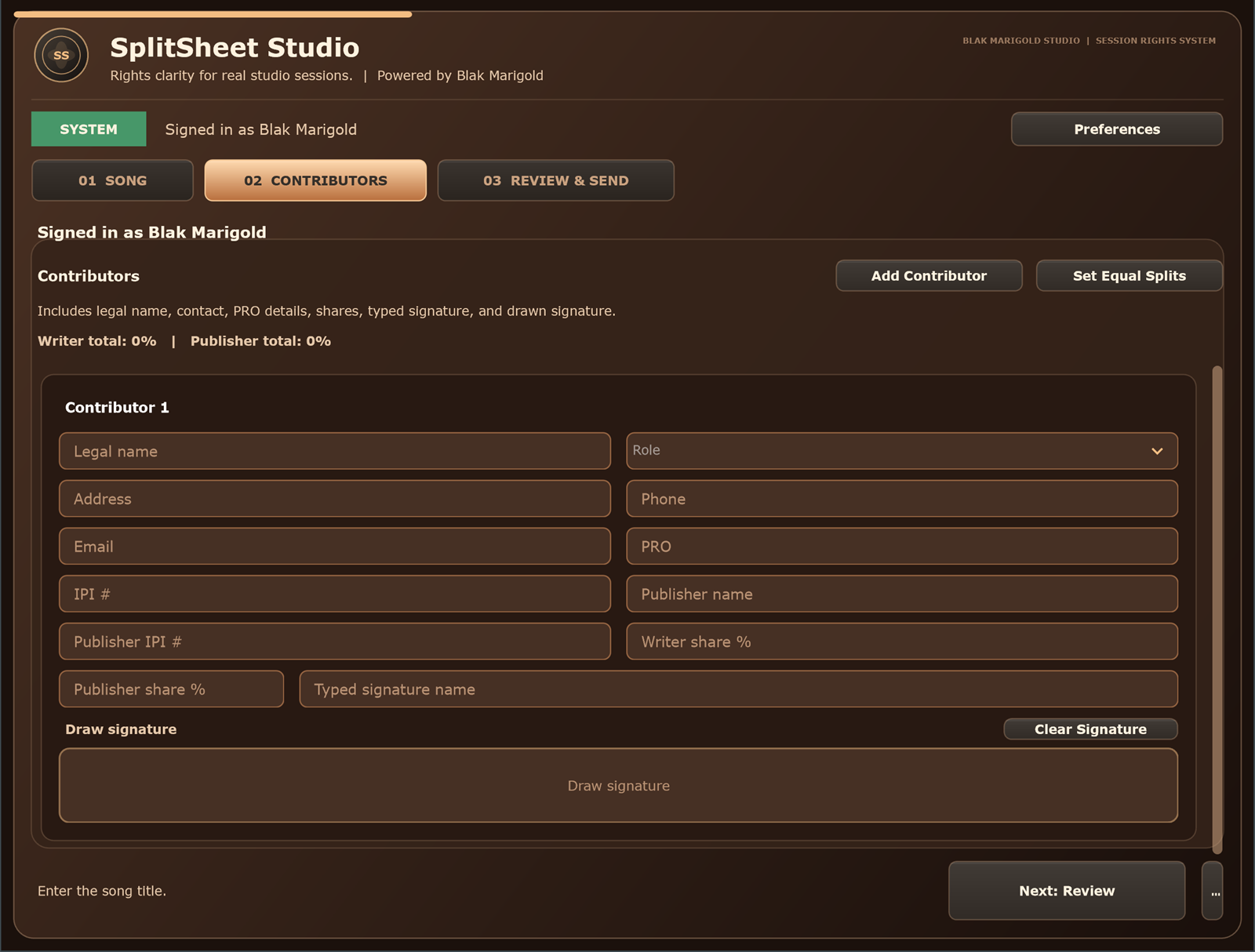
A signed split sheet is the first practical record. It should total 100%, reflect the team agreement, and connect to publishing records later. If the split says one thing and the publisher registration says another, the song may become a clearance conversation instead of a licensing opportunity.
- Confirm the writer legal names and professional names.
- Verify composition shares total 100%.
- Record publishers, administrators, PROs, and IPIs when available.
- Identify who can approve a sync use and who must be copied.
- Store the signed split beside the song metadata.
Map the master side separately
The master is the specific sound recording. A sync use of an existing recording usually needs permission for the master in addition to the composition. The master owner might be the artist, a label, a production company, a studio client, or another party depending on the agreement.
Do not assume master control just because the artist uploaded the release. Review producer agreements, label deals, featured-artist terms, work-for-hire language, studio payment terms, and any contract that affects who can approve the recording.
- Name the exact recording version and ISRC when assigned.
- Identify the master owner and approval contact.
- List producer points, featured artist restrictions, and payment obligations.
- Keep instrumental, clean, and alternate mixes attached to the same record.
Find sample, loop, and beat restrictions early
Uncleared samples, interpolations, loops, and beat licenses are common sync blockers. Some beat licenses allow distribution but restrict television, film, advertising, games, trailers, or commercial licensing. Some sample packs allow use in songs but still require careful review of redistribution and identification terms.
Ask the uncomfortable question before pitching: did any part of this production come from third-party material? If yes, document the source, license, restrictions, and clearance status. Unknown is better than pretending a risk is gone.
Build a sync-ready rights packet
A rights packet is a compact folder that lets a clearance person understand the song without a long back-and-forth. It should include the signed split sheet, composition ownership summary, publisher and administrator contacts, master owner contact, sample notes, metadata, lyrics, audio files, and any restrictions.
For Split Sheet Studio users, the final PDF can become the ownership anchor inside that packet. Add the related audio, metadata, and master notes around it so the song has one source of truth.
- Signed split sheet PDF.
- One-page composition and master ownership summary.
- Publisher, administrator, PRO, and IPI details.
- Full mix, instrumental, clean version, and stems when available.
- Lyrics, explicit status, tempo, mood, genre, themes, and scene-use notes.
- Sample, interpolation, beat-license, and restricted-use notes.
- Approval contacts and expected response time.
Prepare a one-stop response email
When a supervisor asks if a song is clearable, answer like a professional catalog owner. Lead with what you can confirm, avoid overpromising, and attach the right packet.
This song is organized for sync review. We can provide composition ownership, publisher or administrator contacts, master ownership, clean and instrumental versions, lyrics, and sample-status notes. Please send the usage details, media type, territory, term, and budget range so we can confirm final approval and quote accurately.
That tone protects the relationship. It says the catalog is prepared while still leaving room to verify final terms.
What not to claim as one-stop
Do not call a song one-stop when one writer is missing, publishing data is unknown, a producer agreement is unresolved, a sample is uncleared, or the master owner has not authorized licensing. Do not rely on a text thread as the final proof of ownership if the split sheet was never completed.
It is better to pitch a song as clearance-ready or organized for fast clearance than to make a one-stop claim that falls apart under questions. Trust matters more than sounding bigger than the paperwork.
Make one-stop readiness part of session closeout
The easiest time to collect one-stop data is when the session is still fresh. Studios can help by ending every writing or recording session with title confirmation, contributor names, split percentages, master notes, sample notes, and remote signature links.
Use the recording studio session closeout workflow to build this habit into the last five minutes of the room.
Score your song before pitching it for sync
Before sending a track to a library, supervisor, publisher, brand agency, or production company, score it honestly. A song is not ready because it is good; it is ready when the creative, rights, metadata, and delivery pieces are all reachable.
- Green: all rights owners, files, contacts, and restrictions are documented.
- Yellow: ownership is mostly clear, but one or two data points still need confirmation.
- Red: missing signatures, unknown master owner, unresolved samples, or conflicting percentages.
If a song is yellow or red, fix the record before increasing pitch volume. Clean paperwork compounds over time because every future release, registration, and license starts from a stronger base.
Who needs one-stop clearance clarity
Sync producers
A one-stop claim can help a pitch, but only when the composition and master approval path is actually documented and current.
Artists
If you control both sides, prove it with splits, master notes, publisher data, and sample disclosures before a music supervisor asks.
Studios
A closeout workflow turns a finished session into a licensable asset by capturing the facts that clearance teams need later.
Managers
Keep one approval map for every song so quotes, restrictions, and rights-holder responses do not live in scattered texts.
Real session scenario
A supervisor needs a soulful hook for a streaming drama by tomorrow. The song feels perfect, but the artist cannot confirm whether a co-writer assigned publishing or whether the master producer needs approval. The creative fit is there, but the clearance confidence is not.
One-stop clearance map
| Clearance layer | What to document | What can block the license |
|---|---|---|
| Composition | Writers, shares, publishers, PROs, IPIs, and approval contacts. | Missing co-writers, conflicting registrations, or publisher approval rights. |
| Master | Master owner, label or artist contact, producer obligations, and recording version. | Unclear ownership, unapproved featured artists, or unpaid production terms. |
| Third-party material | Samples, interpolations, loops, beat licenses, and restrictions. | No written clearance or a license that excludes sync. |
| Delivery | Instrumental, clean version, full mix, stems when available, lyrics, metadata, and quote contact. | Slow file delivery or metadata that does not match the rights record. |
One-stop readiness checklist
- Verify that signed composition splits total 100%.
- Confirm every publisher, administrator, and approval contact.
- Document who owns or controls the exact master recording.
- List samples, loops, interpolations, and beat-license restrictions.
- Prepare a clean rights packet that can be sent within one business day.
Turn this into a repeatable session system
The best music-rights workflow is boring in the right way: the same fields, same closeout habit, same storage location, and same confirmation path every time. For one-stop music licensing work, that means the team should not wait until release week, a sync pitch, or a payment dispute to collect the facts.
- Before the session: ask who is writing, producing, engineering, featured, managing, or controlling the master.
- During the session: capture names, emails, roles, titles, and any beat, sample, or publishing questions as they come up.
- Before people leave: confirm percentages, approval contacts, and unfinished questions while everyone can still answer.
- After the session: save the completed record beside the audio files, metadata, stems, invoices, and release notes.
That rhythm helps artists, producers, studios, managers, and sync teams move faster because the catalog becomes organized by default instead of cleaned up in a panic.
Green-light questions before you move forward
Before treating this sync licensing workflow as finished, make sure a person outside the session could understand the record without calling everyone back. A strong answer should be specific enough for a collaborator, publisher, studio admin, or sync clearance contact to act on it later.
- Does the record name every person or company that must approve, register, deliver, or receive a copy?
- Do the percentages, identifiers, credits, and contacts match across the split sheet, metadata, distributor upload, and licensing notes?
- Can the team explain what is still unknown without turning the unknown field into a guess?
- Would the same information help a music supervisor, publisher, manager, or studio assistant move faster under a deadline?
Frequently asked questions
What is one-stop music licensing?
One-stop music licensing means one clear approval path can handle the rights needed for a sync use, especially the composition and master rights. The exact scope should be verified before pitching.
Does one-stop mean one person owns everything?
Not always. It can mean one authorized party can approve or coordinate the needed rights, but the team should still document every owner, publisher, administrator, and master contact.
Do I need both composition and master permission for sync?
If the buyer wants to use an existing recording, the use generally needs composition permission and master-use permission.
Can a split sheet make a song one-stop?
A split sheet can document composition ownership, but one-stop readiness also depends on master ownership, publisher authority, samples, restrictions, and approval contacts.
Can uncleared samples block a sync license?
Yes. Samples, interpolations, loops, and some beat licenses can create extra approvals or restrictions that stop a sync use.
What should be in a sync-ready rights packet?
Include the signed split sheet, composition and master ownership summary, publisher contacts, sample notes, lyrics, metadata, audio deliverables, and approval contacts.
Should independent artists pitch songs as one-stop?
Only when they can verify the rights and approval authority. If not, pitch the song as organized for clearance and explain what still needs confirmation.
Why do music supervisors care about one-stop songs?
Supervisors and clearance teams often work under deadlines. Songs with clear ownership, contacts, and files reduce risk and save time.
What is the difference between one-stop and pre-cleared music?
One-stop usually describes the approval path. Pre-cleared can imply rights and terms are already approved for certain uses. Always define the exact meaning in the deal.
How does Split Sheet Studio help with sync clearance?
Split Sheet Studio helps teams capture signed composition splits, contributor details, and final PDFs that can become the ownership anchor in a sync-ready rights packet.