Quick answer: A music supervisor pitch package is the compact set of links, files, rights notes, metadata, and contact information that lets a supervisor evaluate and clear a song with minimal back-and-forth.
What a supervisor needs from your pitch
A supervisor is usually balancing creative fit, clearance risk, budget, timeline, edit needs, and communication speed. Your pitch package should help them move through those filters quickly.
Do not treat the pitch like a fan announcement. Treat it like a professional handoff: here is the song, here is why it fits, here are the usable versions, here is who controls it, and here is how to quote or approve it.
Match the brief before you send anything
If the brief asks for upbeat indie pop with clean lyrics, do not send dark explicit trap because it is your strongest record. Save everyone's time by reading the mood, tempo, lyrical subject, vocal type, era, budget, and clearance requirements.
When a song is close but not exact, explain the useful angle in one sentence. The goal is to help the supervisor imagine the placement, not convince them to reinterpret the brief.
Use a clean listening link
Send a private streaming link that works without forcing account creation. Include track title, artist, short description, explicit status, and download availability. Make sure links do not expire too soon.
If you send a playlist, keep it short and ordered by relevance. A ten-song playlist can work if the first three are clearly the best matches. A fifty-song dump almost never feels helpful.
Prepare the download folder
Have WAV, MP3, instrumental, clean version, lyrics, and stems when available. If you do not want to send downloads immediately, state that files are ready on request.
Every file should be named clearly. Include artist, title, version, and status. Avoid inside jokes, old mix numbers, or confusing abbreviations.
Add a short rights summary
The rights summary should state composition contact, master contact, publisher or administrator info, one-stop status, sample notes, restrictions, and approval timing. It does not need to expose every private deal detail in the first email.
Copyright Alliance notes that sync and master-use permissions can both matter when using an existing recording. A good pitch package makes both paths easy to understand.
Attach metadata and lyrics
Metadata should include genre, mood, tempo, vocal type, language, explicit status, writers, publishers, master owner, ISRC, ISWC when assigned, and contact info. Lyrics help supervisors check scene fit, brand safety, and cue-sheet context.
When possible, include clean lyric notes and alternate lines. A song that can be adapted safely has more placement flexibility.
Use a direct pitch email structure
Keep the pitch email readable on a phone. Use a clear subject line, one-sentence fit, two or three recommended songs, rights status, available versions, and a single contact for next steps.
Subject: Clean soulful R&B for family-drama brief. Sending two one-stop candidates with instrumentals and clean versions ready. Rights summaries are included in the folder, and I can confirm quote/approval timing today.
Follow up without burning the relationship
Follow up once with useful context: a new instrumental, a cleared clean version, or a better match for a later brief. Do not repeatedly ask whether they listened. Track briefs, submissions, responses, and restrictions in your catalog spreadsheet.
Pair this article with the catalog metadata spreadsheet guide so every pitch has better source data.
Who needs a supervisor-ready pitch package
Sync producers
Package songs so supervisors can hear, search, edit, and clear without a long investigation.
Artists
Pitch fewer songs with stronger metadata, versions, and rights confidence.
Managers
Keep pitch materials consistent across publishers, libraries, agencies, and direct supervisor relationships.
Studios
Use the package format to help clients prepare music for TV, film, ads, trailers, and games.
Real session scenario
Two songs fit the brief. One arrives as a streaming link with no rights details. The other arrives with a download link, instrumental, lyrics, ownership summary, and contact. The second song is easier to move forward.
Pitch package layers
| Layer | Include | Avoid |
|---|---|---|
| Creative | Streaming preview, download link, short description, mood, genre, tempo. | Long hype paragraphs with no useful scene detail. |
| Edit-ready | Instrumental, clean, stems, cutdowns, alt endings when available. | Only sending a mastered vocal mix. |
| Clearance | Composition/master contacts, one-stop status, restrictions, sample notes. | Saying one-stop without proof. |
| Admin | Lyrics, identifiers, writer/publisher data, quote contact. | Forcing the supervisor to ask for basics. |
Before sending a pitch package
- Match the brief exactly.
- Send only songs you can clear.
- Include instrumental and clean files where possible.
- Summarize rights status honestly.
- Make quote and approval contacts obvious.
Turn this into a repeatable session system
The best music-rights workflow is boring in the right way: the same fields, same closeout habit, same storage location, and same confirmation path every time. For music supervisor pitch package work, that means the team should not wait until release week, a sync pitch, or a payment dispute to collect the facts.
- Before the session: ask who is writing, producing, engineering, featured, managing, or controlling the master.
- During the session: capture names, emails, roles, titles, and any beat, sample, or publishing questions as they come up.
- Before people leave: confirm percentages, approval contacts, and unfinished questions while everyone can still answer.
- After the session: save the completed record beside the audio files, metadata, stems, invoices, and release notes.
That rhythm helps artists, producers, studios, managers, and sync teams move faster because the catalog becomes organized by default instead of cleaned up in a panic.
Green-light questions before you move forward
Before treating this sync licensing workflow as finished, make sure a person outside the session could understand the record without calling everyone back. A strong answer should be specific enough for a collaborator, publisher, studio admin, or sync clearance contact to act on it later.
- Does the record name every person or company that must approve, register, deliver, or receive a copy?
- Do the percentages, identifiers, credits, and contacts match across the split sheet, metadata, distributor upload, and licensing notes?
- Can the team explain what is still unknown without turning the unknown field into a guess?
- Would the same information help a music supervisor, publisher, manager, or studio assistant move faster under a deadline?
Frequently asked questions
What should I send to a music supervisor?
Send a relevant listening link, short fit note, available versions, lyrics, metadata, rights status, and contact for clearance or quote.
Should I send attachments in the first email?
Usually send links instead of heavy attachments unless requested. Keep files ready for quick download.
How many songs should be in a sync pitch?
Send only the strongest matches. Two to five highly relevant songs often beats a large playlist.
Should I say a song is one-stop?
Only if you can verify that the approval path covers the needed rights.
Do supervisors need stems?
Not always, but stems can help if the song reaches an edit or trailer stage.
Should I include lyrics?
Yes. Lyrics help check story fit, explicit content, brand safety, and cue-sheet details.
What metadata matters most?
Genre, mood, tempo, vocal type, explicit status, writers, publishers, master owner, identifiers, and approval contacts.
How fast should I respond to a supervisor?
As fast as practical, especially when a brief has a deadline. Prepared rights and files make fast replies possible.
Can studios help create pitch packages?
Yes. Studios can deliver clean files, metadata, credits, and split PDFs that help artists pitch professionally.
How does Split Sheet Studio help a pitch package?
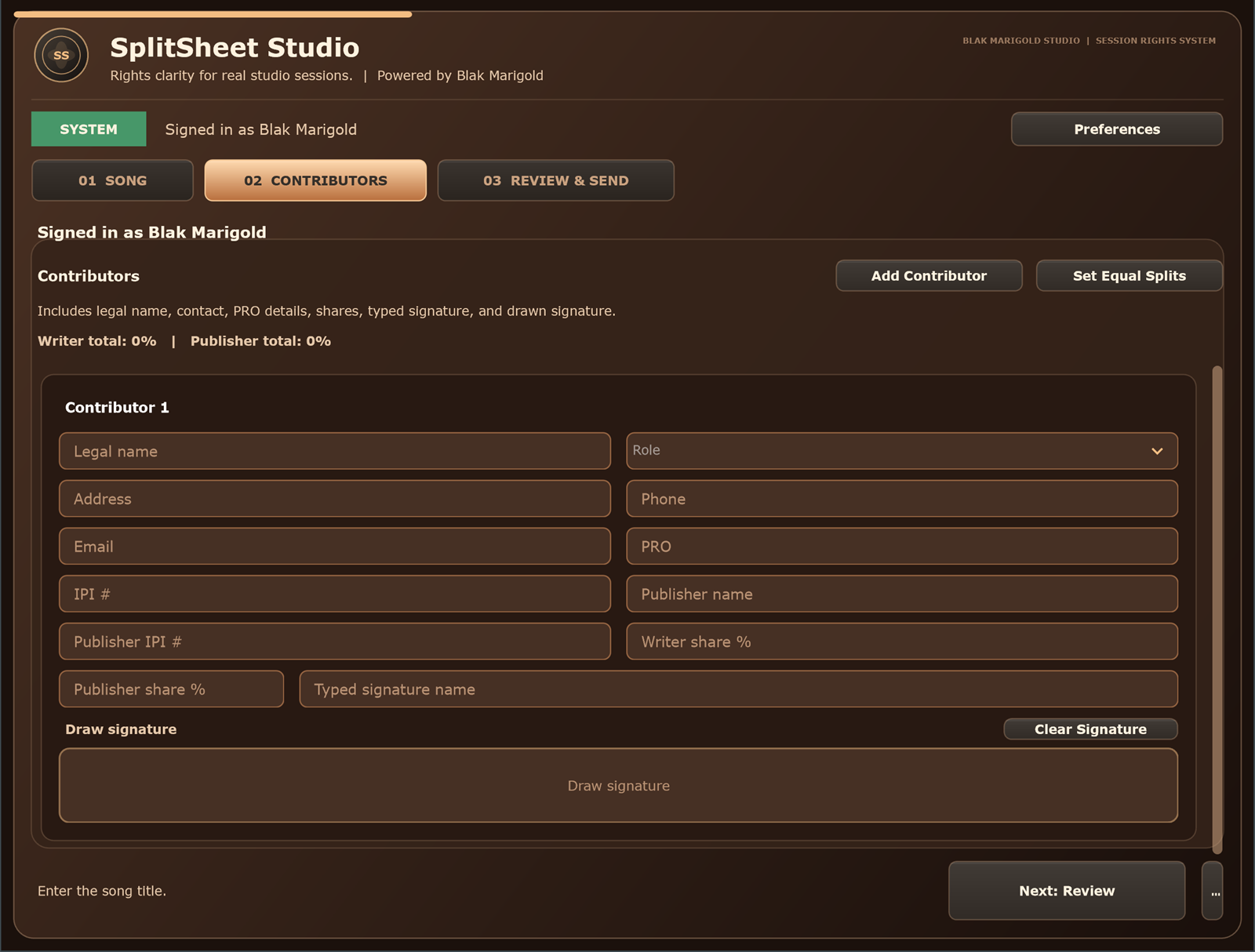
It gives the team a signed ownership record that can support the rights summary in the package.