Quick answer: The best music distribution service in 2026 is the one that matches your release schedule, collaborator workflow, catalog plans, royalty needs, and budget. No distributor is the best fit for every independent artist.
The short version
Choosing a distributor in 2026 is less about finding one company that wins every category and more about matching the pricing model to the way you actually release music. Artists who release often usually get more value from an unlimited annual plan. Artists who release once in a while may prefer paying per release.
That is why the advertised yearly price should never be the only number you compare. Look at cancellation rules, YouTube Content ID, collaborator payouts, cover-song licensing, multi-artist accounts, catalog transfers, and whether a percentage of revenue is taken.
There is also a rights question that belongs before all of those: did everyone who created the record agree on who owns what before it was uploaded? A distributor can move audio to streaming services and route money to collaborators, but it does not automatically establish ownership of the song.
If you are building a release from a professional session, pair this comparison with the artist release paperwork checklist and the studio workflow at Blak Marigold Studio. Clean files and clean paperwork make the distributor choice much easier.
The release principle to remember
The cleanest order is simple: agree on the rights, document them, distribute the recording, then register the remaining royalty sources. Before release, confirm the writers, composition ownership, master ownership, producer participation, credits, and any other relevant deal terms.
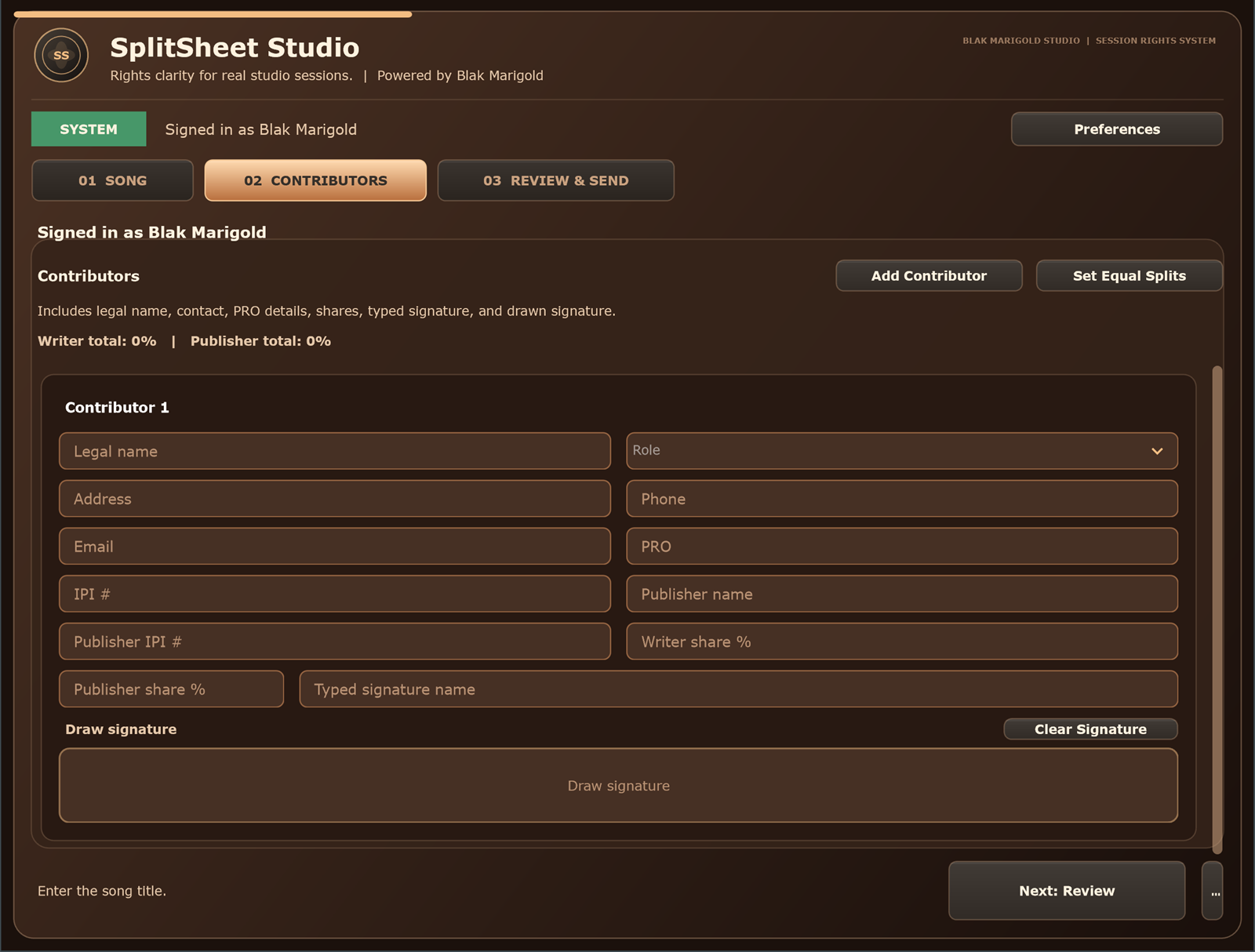
Once those details are clear, the distributor becomes a delivery and accounting choice instead of the place where everyone tries to figure out the deal after the fact. Use a signed split sheet before distribution so the release metadata, registrations, and collaborator payouts are built from the same truth.
What a distributor actually handles
For most independent artists, digital distributors are the connection between the finished master and services such as Spotify, Apple Music, Amazon Music, YouTube Music, TikTok, Instagram, TIDAL, and Deezer. Instead of delivering to every service separately, the artist sends the distributor a master file, artwork, metadata, and release information.
Depending on the company and plan, distribution may also include UPC and ISRC generation, scheduled release dates, lyric delivery, analytics, collaborator payments, social-platform monetization, YouTube Content ID, catalog transfers, and takedowns.
Using a distributor does not automatically mean giving that company ownership of the master copyright. Some agreements can, however, give the distributor exclusive digital-distribution rights during a contractual term. Copyright ownership and distribution authorization are different concepts, and independent artists should read that distinction carefully.
Distribution is only one part of royalties
A streaming release can generate revenue connected to two different copyrights. The composition is the underlying lyrics and music. The master recording is the specific recorded performance listeners hear.
Basic digital distribution primarily concerns the master side. That does not mean every royalty generated by the song has automatically been collected. In the United States, The MLC administers certain digital mechanical royalties for eligible interactive streaming and download services, while SoundExchange collects statutory digital-performance royalties for sound recordings used by qualifying non-interactive digital services.
Some distribution companies offer publishing administration, SoundExchange-related collection, sync pitching, or other rights services as add-ons. Evaluate those services separately from the basic question of getting the recording onto DSPs.
2026 music distribution comparison
The pricing notes below were checked in September 2026 from the article draft. Distributor plans change frequently, so verify the current terms before opening an account or moving an established catalog.
| Distributor | Starting price | Standard DSP royalty model | Releases | Useful distinction |
|---|---|---|---|---|
| DistroKid | $24.99/year | 100% to artist | Unlimited | Fast DIY workflow with many optional extras. |
| TuneCore | $24.99/year | 100% to artist | Unlimited | Strong reporting, splits, and publishing ecosystem. |
| Too Lost | $19.99/year | 100% while subscribed | Unlimited | 450+ destinations and a label tier for larger catalogs. |
| LANDR | $24/year | 100% | Unlimited | Content ID included and catalog retention options after cancellation. |
| CD Baby | $9.99 single | 91% of digital distribution revenue | Pay per release | No recurring distribution subscription. |
| UnitedMasters | $19.99/year | 100% on paid plans | Unlimited | SELECT adds brand and sync opportunities. |
| Amuse | $23.99/year | 100% standard DSP royalties | Unlimited | Music can remain online after cancellation with commission. |
| RouteNote | Free | Artist keeps 85% | Unlimited | Free and premium models available. |
| SoundCloud for Artists | $39/year | 100% | 2 distributed tracks/month on Artist | Distribution integrated with SoundCloud audience tools. |
| Symphonic Starter | $29.99/year | 100% standard distribution royalties | Unlimited | Strong analytics and free collaborator splits. |
| Soundrop | $4.99/track | Artist keeps 85% | Pay per track | Cover-song licensing included. |
| Ditto Music | $19/year | 100% standard distribution | Unlimited | Pro adds publishing, sync, and Content ID. |
| Horus Music | GBP20/year | 100% | Unlimited | Low-cost global distribution. |
| OFFstep | From $1.50/month | 100% | Unlimited | Budget-focused DIY distribution. |
| AWAL | Application based | Artist receives 85% of qualifying distribution receipts | Selective | Artist-services model rather than open DIY distribution. |
How to compare pricing models
Unlimited annual plans are attractive when you release singles, alternate versions, remixes, beat-tape style projects, or multiple artists under one workflow. The risk is that the subscription may become the catalog's access fee, so cancellation terms matter.
Pay-per-release models can make sense for slower catalogs because the artist does not keep paying every year just to maintain a small number of releases. The tradeoff is usually a revenue percentage, per-track fee, or fewer platform-style add-ons.
Artist-services and selective platforms are a different category. They may offer marketing, sync, analytics, advances, playlist strategy, brand opportunities, or higher-touch campaign support. Those services may be valuable, but they should be judged against your actual team, not against a basic distributor's upload form.
Best fit by artist situation
- Frequent independent releasers: compare DistroKid, TuneCore, Too Lost, LANDR, Ditto, Amuse, Symphonic, Horus Music, and OFFstep first.
- Occasional releasers: compare CD Baby and Soundrop against annual-plan costs over three years, not only the first upload.
- Cover-song focused artists: study Soundrop, DistroKid, LANDR, and any platform that makes mechanical cover licensing part of the workflow.
- Teams with many collaborators: prioritize splits, payout routing, exportable statements, and clean metadata before chasing the lowest advertised price.
- Sync-minded artists: choose distribution that does not make clearance harder. Then keep split sheets, master ownership, instrumental files, and approval contacts organized.
- Artists who record professionally: connect the release process to studio handoff. The Blak Marigold recording studio and session closeout workflow are built around that exact handoff.
Features that matter more than the headline price
Compare the fine print before you compare logos. Content ID can be included, optional, restricted, or unavailable depending on the plan. Collaborator splits can be free, paid, manual, or limited to certain revenue types. Cover-song licensing can be handled inside the platform or left to the artist.
Catalog permanence is another major issue. Some services remove releases if the subscription lapses. Others keep music online with a commission, permanent-release option, or legacy arrangement. If you are moving a catalog, confirm transfer rules and preserve the same ISRCs when possible so stream history and royalty matching stay cleaner.
Finally, check whether the platform supports the way you actually work: multiple artist names, label accounts, pre-save tools, TikTok and Instagram delivery, lyric delivery, YouTube monetization, analytics exports, royalty statements, payment thresholds, and territory restrictions.
Rights to settle before upload
Before uploading the master, answer the ownership questions that will become expensive later. Who wrote the composition? What are the writer shares? Who owns or controls the master? Are there producer points, master royalties, featured artist approvals, samples, loops, beat licenses, or label obligations?
Split Sheet Studio exists for this exact moment. Use the split sheet builder to capture the composition record, then store the final PDF beside release metadata, artwork, lyrics, ISRCs, UPCs, and master notes. If the team needs a repeatable workflow, the Split Sheet Studio plans are built for artists, producers, managers, and studios that release often.
Switching distributors without making a mess
Many artists eventually move a release from one distributor to another. Before doing that, collect the UPC, ISRCs, release date, exact audio files, artwork, contributor metadata, songwriter and publisher details, and takedown timing. Preserve ISRCs whenever possible so stores can connect the new delivery to the existing recording identity.
Do not deliver the same active release through two distributors at the same time unless you are following a transfer process the stores and distributors support. Duplicate deliveries can create conflicts, takedowns, split reporting, and catalog confusion.
Final recommendation
If you release constantly and want speed, start with unlimited annual plans. If you release rarely, run the math on pay-per-release services. If you want marketing, sync, brand opportunities, or a more curated team, look at higher-touch services with realistic expectations.
But do not let the distributor become the first place your team discusses ownership. Finish the split sheet, clarify the master, save the paperwork, then distribute the recording. That order protects the release, the collaborators, and every future opportunity attached to the song.
Frequently asked questions
What is the best music distribution service in 2026?
There is no single best service for every artist. Compare release frequency, total cost, cancellation terms, collaborator splits, Content ID, cover-song licensing, catalog transfers, and whether the platform takes a revenue share.
Do I need a distributor to get music on Spotify?
Most independent artists use an approved digital distributor to deliver music, artwork, metadata, and release information to Spotify and other DSPs.
Which distributors advertise 100% royalties?
DistroKid, TuneCore, Too Lost, LANDR, Ditto, Amuse, and Symphonic advertise 100% standard streaming or download royalties on certain paid plans, but add-ons, commissions, taxes, payment fees, or special services can still affect the final money received.
Does a music distributor own my master?
A distributor does not automatically own your master just because it delivers the release, but some agreements include exclusive distribution rights or other restrictions. Read the terms before uploading.
Can I use different distributors for different releases?
Yes. Many artists use different distributors for different releases or catalogs. The same active release should not normally be delivered by two distributors at once except during a supported transfer.
Does distribution collect publishing royalties?
Basic distribution usually focuses on the master recording side. Publishing administration, MLC registration, PRO registration, and SoundExchange collection may require separate steps or add-on services.
Is a distributor split the same as a split sheet?
No. A distributor split is usually a payment routing feature. A split sheet documents the ownership agreement for the song, especially composition shares.
What happens if I cancel my distributor?
It depends on the platform. Some releases may be removed, some can stay online through a legacy commission, and some require an optional leave-a-legacy or catalog-retention feature.
Which distributor is best for cover songs?
Soundrop is known for cover-song licensing in its workflow, and some other platforms offer cover licensing options. Always confirm current rules before releasing a cover.
Should I keep the same ISRC when switching distributors?
Yes, when possible. Keeping the same ISRC helps identify the same recording across services and can reduce catalog confusion during a transfer.